Preparing for II PUC board examinations while also working towards JEE, NEET or KCET can be difficult to manage. Students have to understand concepts for their board syllabus and then apply many of those concepts in competitive exam questions. MVJ Pre-University College uses its C-U-P learning approach to bring these two parts of preparation into the same academic routine. For students looking for PU Science preparation alongside entrance coaching, the approach keeps classroom teaching, board preparation and competitive-exam practise connected.
What Is the C-U-P Learning Approach?
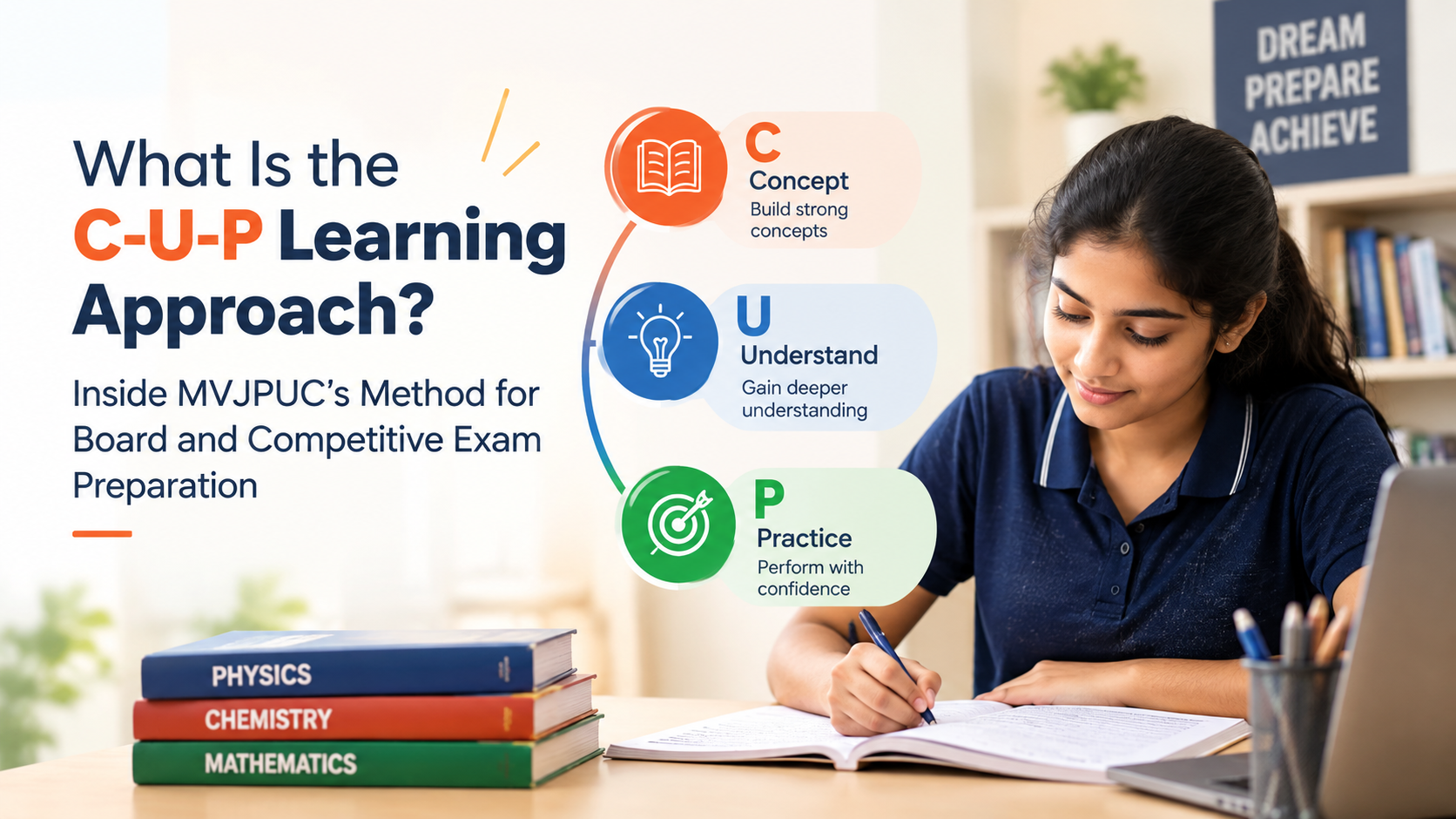
C-U-P is an integrated learning approach used at MVJ Pre-University College (MVJPUC). It divides the learning process into three distinct phases: Concentrate, Understand, and Practise.
Rather than treating board coursework and competitive coaching as isolated tracks, the MVJPUC learning approach combines classroom teaching, conceptual understanding, and supervised practise within its regular PU programme. The idea is simple: students first focus on the topic, then work to understand it, and finally practise what they have learned.
How Does the C-U-P Approach Work?
The approach structures classroom sessions into three clear steps:
- C – Concentrate: Each session begins with a quick revision of previous topics and important questions, helping students focus on the concepts being taught that day.
- U – Understand: Students learn through an integrated, concept-based teaching approach that focuses on understanding and applying the topic before moving into competitive-exam practise.
- P – Practise: Post-class preparation time is built directly into the student schedule. Students then get dedicated time to practise the topic with faculty available to help.
How Does C-U-P Help With Board Exam Preparation?
For board exam preparation, MVJPUC combines regular tests, class notes, question banks and board-focused practise. Students can revise the syllabus regularly and practise board-style questions aligned with the final state board examinations.
How Does C-U-P Support JEE, NEET and KCET Preparation?
Board examinations and entrance tests require students to use their knowledge differently. JEE Main and NEET are national-level entrance examinations for engineering and medical admissions respectively, while KCET is Karnataka’s state-level entrance examination for several professional courses, including engineering.
Students receive online assignments containing previous-year JEE, NEET, KCET and board questions, giving them early exposure to competitive examination patterns. Regular objective tests give students practise time management and accuracy before the actual examination. Practising these questions soon after the concept is taught helps students connect what they have learned with multiple-choice problem-solving.
What Academic Support Does MVJPUC Provide?
MVJPUC also supports the daily classes with study materials, tests, mentoring and revision resources:
- Printed Courseware & Class Notes: Study materials, class notes and question banks provided directly to students.
- Online Objective Testing: Regular objective tests and performance analysis to help students review their preparation.
- NCERT-Based Concept Maps: Concise visual summaries that help students revise important concepts quickly.
- Laboratory Facilities: Fully equipped laboratories support practical learning alongside classroom instruction.
- Post-Board Crash Course: An intensive coaching programme conducted after the board exams to focus entirely on final entrance exam preparation.
- Mentoring & Counselling: Experienced faculty provide regular tests, feedback, student counselling, and systematic updates to parents.
Which Science Courses Include Competitive Exam Preparation?
MVJPUC provides two primary combinations in the science stream that incorporate entrance coaching:
- PCMB (Physics, Chemistry, Mathematics, Biology): This combination is suited to students considering both medical and engineering pathways, with preparation for NEET and KCET.
- PCMC (Physics, Chemistry, Mathematics, Computer Science): This combination is suited to students focusing on engineering and technical disciplines, with preparation for JEE Main and KCET.
Both combinations follow the C-U-P learning approach, while the competitive preparation is aligned with the specific subjects and entrance exams associated with each stream.
Conclusion
The C-U-P approach gives students a clear routine: revise previous work, understand the new topic, and then practise it immediately. At MVJPUC, this structure is used alongside board preparation, competitive-exam assignments, regular tests, and mentoring. For students preparing for JEE, NEET, or KCET, the aim is to keep board and entrance preparation connected rather than treating them as two separate study plans.
FAQs
1. What does C-U-P stand for at MVJPUC?
C-U-P stands for Concentrate, Understand, and Practise. It represents a daily learning routine where students revise previous topics to focus on the current lesson, study through concept-based teaching, and engage in supervised practise sessions.
2. How does C-U-P help with board exam preparation?
The approach builds conceptual clarity during teaching and reinforces it through class notes, question banks, regular tests and board-focused practice. This gives students regular opportunities to work with the type of questions they will encounter in the II PUC examination.
3. Does MVJPUC provide NEET preparation?
Yes. MVJPUC provides NEET preparation for students in the PCMB combination, with previous-year question assignments, regular tests, question banks and a post-board crash course.
4. Does MVJPUC provide JEE Main preparation?
Yes. JEE Main preparation is offered with the PCMC combination, alongside KCET preparation. Students receive printed courseware, question banks, online assignments and regular tests as part of the preparation.
5. How does MVJPUC prepare students for KCET?
KCET preparation is integrated into both the PCMB and PCMC science tracks. Students practise state-level entrance questions through online assignments and experience simulated exam conditions to improve their speed and accuracy before the test.